




Scientific Insights
An area dedicated to healthcare professionals: updates on studies, research, and new clinical perspectives
12/12/2024
Plantar dyshidrosis: clinical presentation, etiopathogenesis and therapeutic management
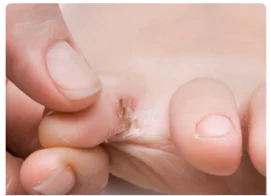
Plantar dyshidrosis, or dyshidrotic eczema of the feet, is an acute, chronic, or recurring dermatitis characterized primarily by the appearance of itchy—or sometimes asymptomatic—blisters on the soles of the feet. While not contagious, the condition can be long-lasting, with episodes persisting for weeks. Its etiopathogenesis is complex and multifactorial, potentially involving genetic predisposition, stress, hyperhidrosis (excessive sweating), intolerances, intestinal infections, and exposure to irritants. The condition is often exacerbated by the use of enclosed footwear and exposure to humid environments.
Clinically, dyshidrosis manifests as small (approximately 1 mm), deep-seated serous blisters. These may appear individually or coalesce, causing intense itching; the subsequent rupturing of the blisters can lead to skin erosions, crust formation, and an increased risk of bacterial infection. During the resolution phase, the skin typically becomes dry and scaly, and painful fissures may develop.
Management of plantar dyshidrosis involves a combination of proper hygiene, the use of breathable footwear, moisture control, and stress management, with topical corticosteroids serving as the first-line treatment. In resistant cases, immunosuppressants may be used, while soothing and antiseptic agents can provide additional support during the treatment process.
In a study conducted by the team of Dr. Matteo Compagnoni—a podiatrist and kinesiologist at the University of Tor Vergata—a case was reported involving a 33-year-old man who had suffered from plantar dyshidrosis for five years, characterized by seasonal flare-ups and eczematous manifestations on his right foot. Given the mild nature of the condition, the patient was treated with NormoZinc, an emulsion spray containing zinc oxide, calamine, and hyaluronic acid, which provides soothing, astringent, antimicrobial, regenerative, and moisturizing effects. The treatment led to a progressive reduction in symptoms, ultimately resulting in the complete remission of the clinical condition and a significant decrease in plantar hyperhidrosis. Prevention, patient education, and follow-up are essential for long-term management.
Reference: Plantar dyshidrosis: causes, symptoms, and treatments, Lapelle.it, Dr. Matteo Compagnoni, Podiatrist, Kinesiologist (MSc in Diabetic Foot Care), Endocrinology-Diabetic Foot Unit, CTO, University of Rome Tor Vergata; Available online:
https://lapelle.it/la-disidrosi-plantare-cause-sintomi-e-trattamenti.html
Further Scientific Insights
 Featured
13/02/2025
Role of myo-inositol in the treatment of acne associated with polycystic ovary syndrome
Acne is a disorder of the pilosebaceous unit. It is characterized by a highly complex etiopathology that includes inflammation, hyperkeratinization, increased sebum production, colonization by Cutibacterium acnes, hyperandrogenemia, and hyperinsulinemia.
Learn more
20/11/2024
Insulin resistance and bladder dysfunction: new therapeutic perspectives
Recently, there has been growing interest in the complex and diverse functions of insulin—not only as a regulator of blood glucose, but also as a growth factor and biological regulator.
Learn more Featured
20/03/2025
Acne associated with polycystic ovary syndrome: an integrated therapeutic approach
Acne in women, particularly those with Polycystic Ovary Syndrome (PCOS), is a clinical manifestation frequently associated with hyperandrogenism.
Learn more