




Sanitpharma Magazine
Your space for daily well-being: useful content, interesting facts, and advice on health and prevention
14/11/2024
The power of the pomegranate: the autumn fruit that revolutionizes your health
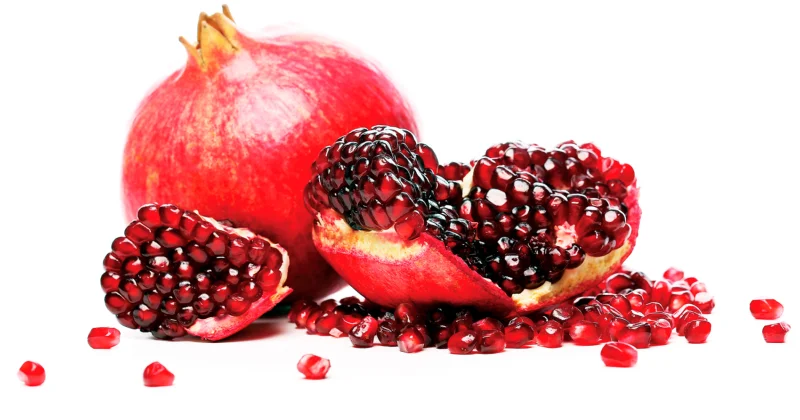
The pomegranate—the fruit of the Punica granatum plant, which belongs to the Punicaceae family—is native to southwestern Asia but is now widely cultivated in Mexico, Arizona, California, and the Mediterranean regions of Europe. Pomegranate shrubs are drought-resistant and thrive in arid zones or areas with a typical Mediterranean climate; they can withstand frost but do not tolerate overly humid environments. The pomegranate is a unique type of berry, typically bright red in color, containing numerous seeds (known as arils) inside. These arils are also bright red, tender, and succulent, with a slightly tart flavor.
This autumn fruit is excellent consumed on its own, or as juice or jam. The juice is obtained by pressing the internal seeds, retaining all of their active ingredients and beneficial properties.
Historical background
The use of the pomegranate in medicine has very ancient roots. One of the earliest mentions of it dates back to the Ebers Papyrus, from around 1550 BC—a papyrus scroll 20 meters long and 20 centimeters high, divided into 108 pages, containing various types of remedies and a large number of medical prescriptions. The ancient Egyptians used the root of the pomegranate as a vermifuge (an agent to expel parasitic worms).
Hippocrates considered this fruit a remedy to be used as an anthelmintic and anti-inflammatory, as a treatment for chronic diarrhea, and as an antibacterial agent for skin infections. In traditional Georgian medicine, it was used to treat passive hemorrhages, infected wounds, and night sweats, while in India, the juice was used as a remedy for infertility.
Nutritional properties and benefits
From a nutritional standpoint, the pomegranate is rich in minerals: 100 grams of the edible portion contain potassium (236 mg), phosphorus (36 mg), magnesium (12 mg), calcium (10 mg), and vitamins (notably vitamin A and vitamin C). It also contains significant amounts of sodium and iron—though the latter has low bioavailability—while zinc, manganese, and copper are present only in trace amounts [1].
Thanks to its generous potassium content, the pomegranate acts as an effective depurative agent, promoting diuresis and, consequently, the elimination of waste products and toxins. Potassium also plays a role in regulating blood pressure. Pomegranates are a good source of both soluble and insoluble fiber, which help maintain intestinal health and support proper digestion. By promoting peristalsis—and thus the elimination of stool—they are particularly beneficial for those suffering from constipation.
Furthermore, as an excellent source of water, the pomegranate is recommended for individuals who lose significant amounts of fluid—such as those who engage in high levels of physical activity—as well as for those at risk of dehydration, including the elderly. Pomegranate fruit is free from cholesterol, lactose, gluten, and histamine. The consumption of ellagitannins—found in pomegranate juice—can help reduce cardiovascular risk by counteracting the action of free radicals.
Thanks to the presence of polyphenols, such as ellagic acid and tannins, the pomegranate exhibits significant antibacterial, anti-inflammatory, and antioxidant properties. These help combat infections caused by bacteria and parasites, affecting the gastrointestinal, respiratory, and urinary tracts. The polyphenolic complex extracted from the pomegranate also exerts a potent antibacterial effect against Escherichia coli—the primary cause of cystitis, which is the most common and frequent type of urinary tract infection. In this context, a dietary supplement containing cranberry and pomegranate can be highly beneficial, as these ingredients support healthy urinary tract function.
Disclaimer
The following information is provided for general guidance only and does not in any way replace professional medical advice. To ensure a healthy and balanced diet, it is always best to rely on the recommendations of your own physician or a nutrition expert.
[1] https://www.humanitas.it/enciclopedia/alimenti/frutta/melograno/
Other articles from the Magazine

15/10/2026
Skin barrier health: from chronic conditions to new dermocosmetic strategies
Our skin is much more than a simple covering: it is a complex ecosystem, a sophisticated defensive barrier, and the primary reflection of our physical and mental well-being.
Learn more
15/10/2026
“Keeping an eye on” well-being: taking care of your eyesight every day
Our vision is with us at every moment of the day. Reading, working, driving, and using smartphones or computers are daily activities that place constant demands on our eyes.
Learn more Featured
09/07/2025
Perfect feet for summer: how to say goodbye to calluses and cracked heels
Sanitpharma
With the holidays just around the corner, it’s time to make room in your closet for tank tops, shorts, and sandals. But are your feet truly ready to enjoy the summer heat—whether displayed in open-toed footwear or left completely bare on beaches and lawns?
Learn more