




Sanitpharma Magazine
Your space for daily well-being: useful content, interesting facts, and advice on health and prevention
19/02/2024
The diabetic foot: when health starts from the ground up
The foot is an organ of both sensation and movement; its structure is a unique masterpiece of architecture—or, more precisely, biomechanics—comprising 26 bones, 33 joints, and 20 muscles. It serves as the fixed point of contact with the ground, bearing the entire weight of the body. It acts as the foundation for the anti-gravity control system (the postural or equilibrium system), which enables humans to maintain an upright posture and move through space. The human foot is a work of nature’s art: its complex anatomical structure reflects the manifold functions it must perform while taking more than 15,000 steps each day.
When discussing a delicate or fragile foot, one must address the "diabetic foot." This term refers to a range of alterations in the lower limb caused by polyneuropathy (a disorder of the nerve fibers) and/or arteriopathy (a disorder affecting one or more arteries). Should an infection occur in the presence of either of these complications, the clinical situation can rapidly deteriorate.
Polyneuropathy leads to a deficit in tactile, pain, pressure, and proprioceptive sensation (the latter being the mechanism that allows specific areas of the nervous system to receive signals from joints, tendons, and muscles). This deficit causes the adoption of abnormal postures that place strain on joints and tendons, eventually leading to irreversible deformities; these, in turn, cause trauma and alter the distribution of pressure on the sole of the foot. This results in the formation of hyperkeratosis (thickened skin), which can damage the underlying tissue and carry a risk of infection. Another consequence of polyneuropathy is an alteration in skin hydration, causing the foot to appear dry and cracked. Arteriopathy may manifest as calf pain following muscular exertion and, in most cases, affects both limbs. It is essential for diabetic patients to undergo regular podiatric examinations to help prevent the development of foot ulcers.
Furthermore, it is recommended to follow a few practical tips:
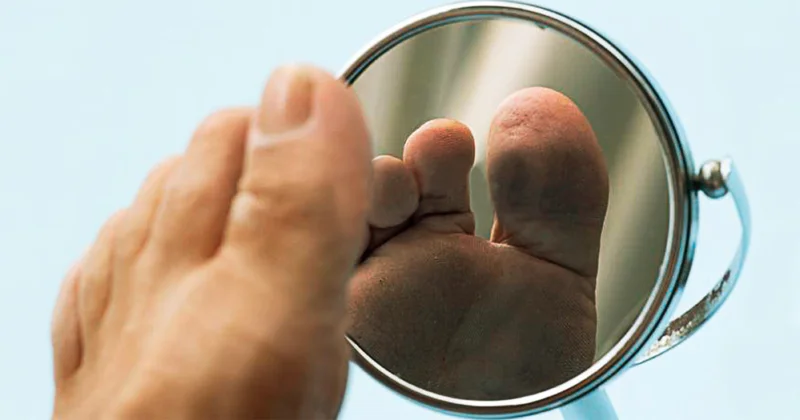
- Examine your feet once a day using a mirror to check for any skin changes, such as blisters, cuts, or redness; ensure there is no excessive moisture between your toes
- Before washing your feet, check that the water temperature is lukewarm by testing it with your elbow; dry your feet—especially between the toes—thoroughly and gently
- Do not place your feet too close to heat sources, such as heaters or hot water bottles; if your feet feel cold, wear wool socks
- Do not use corn-removal products, razor blades, scalpels, or any other sharp objects.
- Keep the skin hydrated and supple by using specific products recommended by a podiatrist—products designed for skin that requires extra nourishment and intensive, consistent, long-lasting hydration. This is particularly important for the delicate skin on the feet and legs of elderly individuals or, more generally, vulnerable people; daily application helps maintain the integrity of the skin on the feet and legs
- Trim your toenails correctly (not too short, and do not cut into the corners); consult a podiatrist if you have difficulty trimming them
- Wear footwear recommended by a specialist; inspect the inside of your shoes before putting them on to ensure there are no foreign objects
- Wear socks (ideally white) that do not have raised seams; wash and change your socks every day
- During periodic check-ups, inform your podiatrist of any changes you have observed in your feet
- If you use or have been prescribed custom-made orthotic insoles, consult a qualified podiatrist
It is therefore essential not to neglect foot health: a minor discomfort can, in a short amount of time, escalate into acute or chronic pain. The well-being of the entire body depends on the well-being of the feet, as well as on proper walking mechanics and good posture.
By Dr. Pietro Peluso, Podiatrist, Peluso Podiatry Practice, Avellino
Other articles from the Magazine

15/10/2026
Skin barrier health: from chronic conditions to new dermocosmetic strategies
Our skin is much more than a simple covering: it is a complex ecosystem, a sophisticated defensive barrier, and the primary reflection of our physical and mental well-being.
Learn more
15/10/2026
“Keeping an eye on” well-being: taking care of your eyesight every day
Our vision is with us at every moment of the day. Reading, working, driving, and using smartphones or computers are daily activities that place constant demands on our eyes.
Learn more Featured
09/07/2025
Perfect feet for summer: how to say goodbye to calluses and cracked heels
Sanitpharma
With the holidays just around the corner, it’s time to make room in your closet for tank tops, shorts, and sandals. But are your feet truly ready to enjoy the summer heat—whether displayed in open-toed footwear or left completely bare on beaches and lawns?
Learn more